Deal Meridian
Empowering real-estate brokers with a CRM that surfaces genuine leads and evolving client preferences
TL;DR
Deal Meridian (now Accolade) is a broker focused PropTech platform designed to strengthen trust, improve lead credibility, and support evolving client preferences in India’s fragmented real-estate market. When we began the project, the opportunity lay in rethinking how brokers manage leads and interpret behavioral signals without relying on over-automated CRM systems.
During the project, I led research and interaction design to shape the future direction of a renter-facing app and broker CRM system. I played a key role in defining how AI could function as an assistive layer, surfacing behavioral patterns and preference evolution, while preserving broker expertise and decision-making in a trust-driven ecosystem.

Team
1 Founder
1 COO
8 HCI Graduate Students

Tools Used
Figma, Miro, Google Workspace

Team
4 months (Aug ‘24 - Dec ‘24)
Impact
Validation sessions with brokers revealed strong product-market alignment for a signal-driven CRM approach.
The system enabled faster lead prioritization, reduced manual verification effort, and surfaced meaningful behavioral insights, leading brokers to consistently favor assistive signals over traditional scoring models.
Workflow efficiency opportunity identified in lead verification and follow-ups
Lead prioritization in signal-based triage scenarios
Brokers favored assistive signals over numeric match scoring
Context
Deal Meridian is a NYC-based PropTech company looking to expand into the urban Indian real-estate market, where property discovery is fragmented, trust is fragile, and brokers remain central despite the rise of PropTech platforms.
Our studio team was brought in to explore the property discovery ecosystem and design a solution that improves the experience for renters, buyers, and brokers while aligning with Deal Meridian’s long-term business goals.
What We Observed in the Current Journey
Discovery
Inquiry
Verification
Conversation Shift
Reference Evolution
Matchmaking Attempt
Browses listings
Submits inquiry
Responds to Broker’s Call
Moves to WhatsApp
Changes budget/ location
Reviews property
Displays filtered listings
Sends raw lead data
No updates documented
Static filters
Receives applied filters
Calls to manually verfiy intent
Tracks conversations manually
Has to remember all changes manually
Suggests properties based on experience
Problem Space
Despite the presence of CRMs in the market, brokers face three core challenges:

Lead Quality
Uncertainty
Brokers spend significant time validating leads without clear signals of seriousness or conversion likelihood.

Static Client Profiles
and Preferences
Most CRMs treat preferences as fixed inputs rather than evolving patterns.

Fragmented Communication
Brokers spend significant time validating leads without clear signals of seriousness or conversion likelihood.
Problem Statement
How might we help brokers identify genuine leads and understand client preferences in real time, so they can use their expertise and local knowledge to match clients with the right properties?
Design Highlights
Deal Meridian Broker CRM is a decision supporting platform that amplifies broker expertise through contextual behavioral signals, not automated scores.
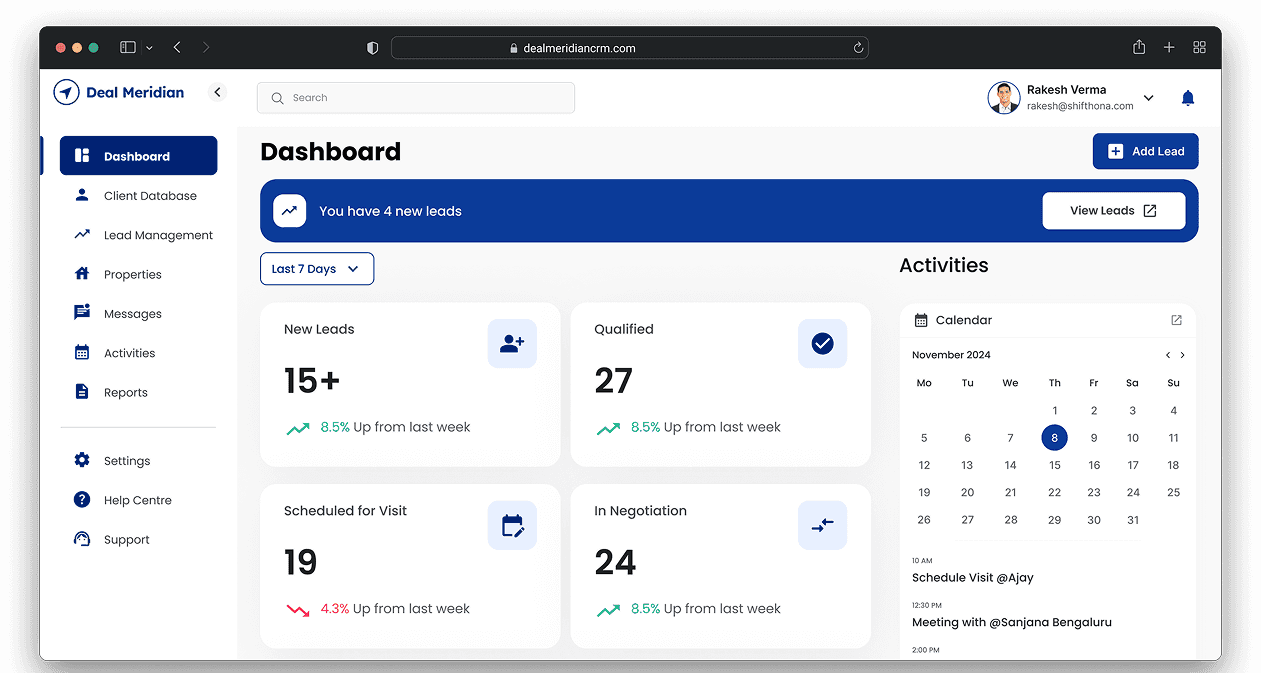
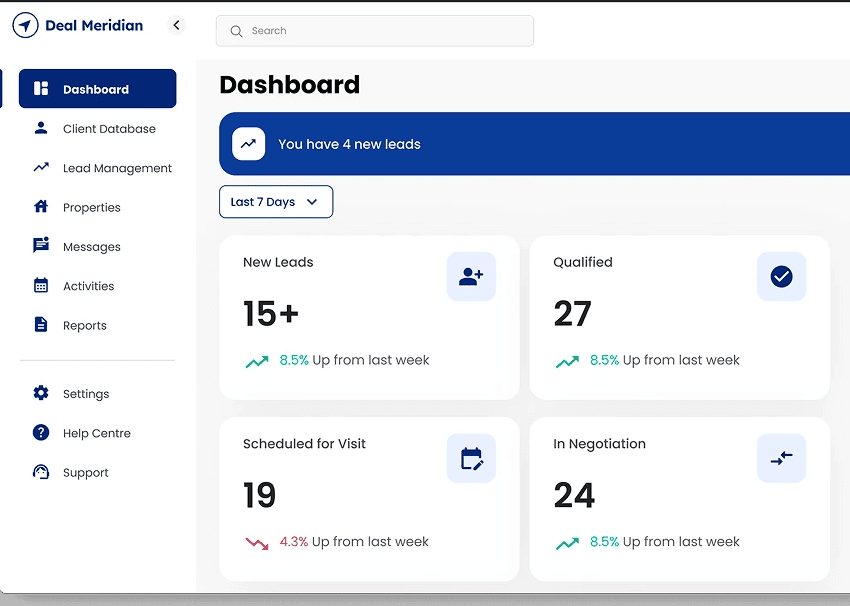
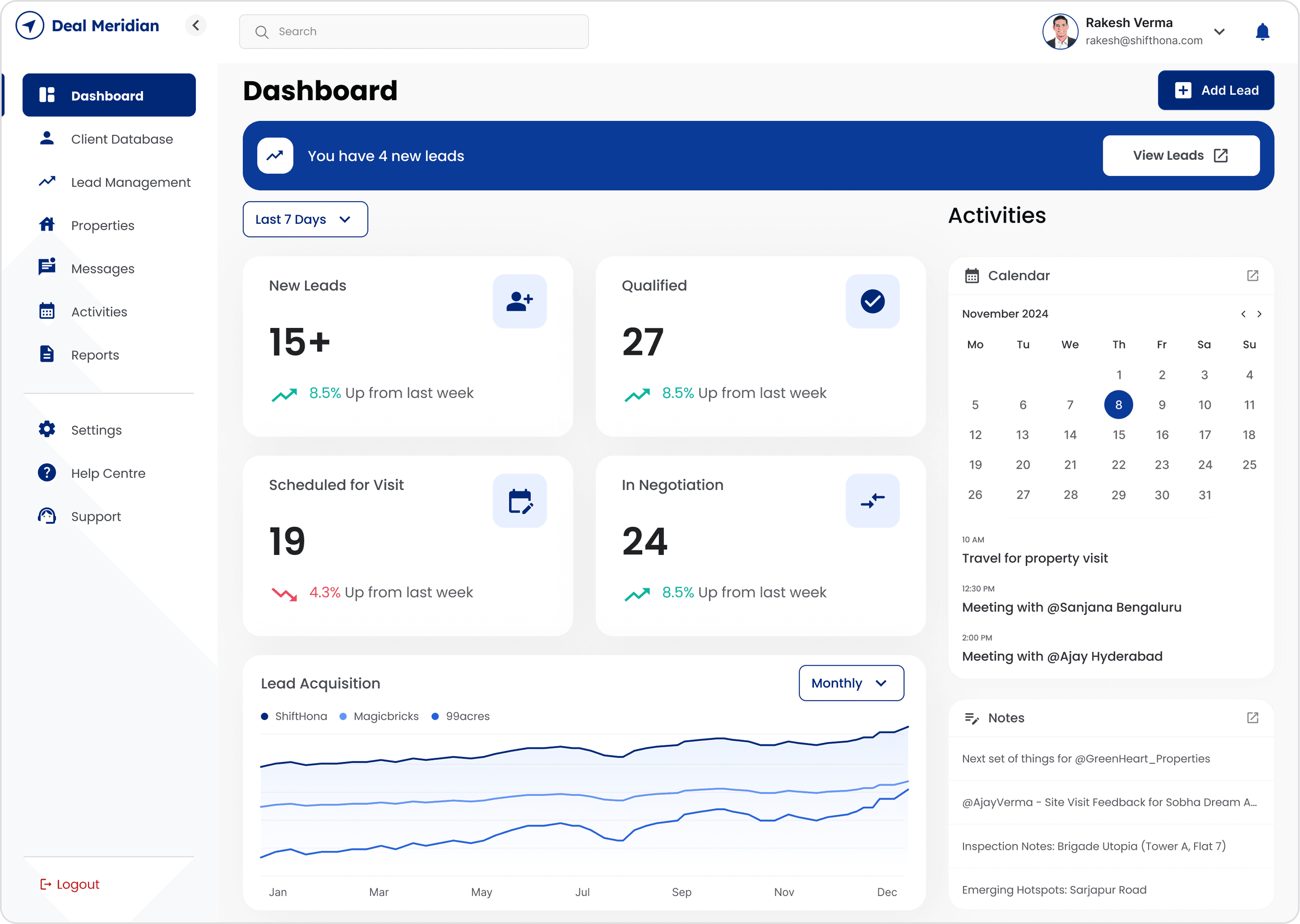
The CRM Dashboard centralizes lead management, task tracking, and client organization. Brokers can quickly access new leads, add offline referrals, take notes, manage daily tasks via an integrated calendar, and track lead sources to optimize engagement.
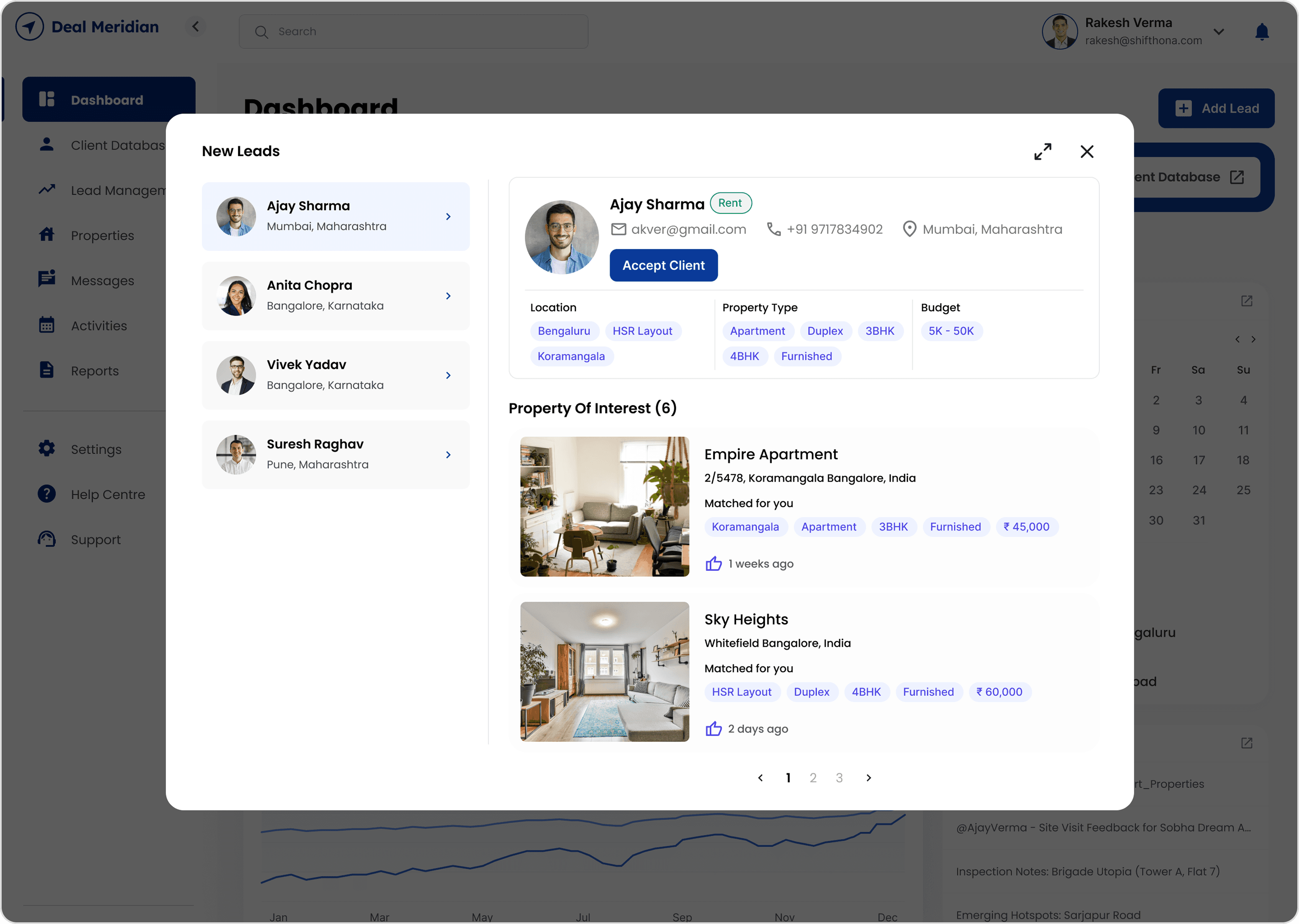
The New Leads popup provides brokers with key client details- property interests, location, contact info, and past activity, helping them quickly assess lead quality and decide whether to add the client to their database.
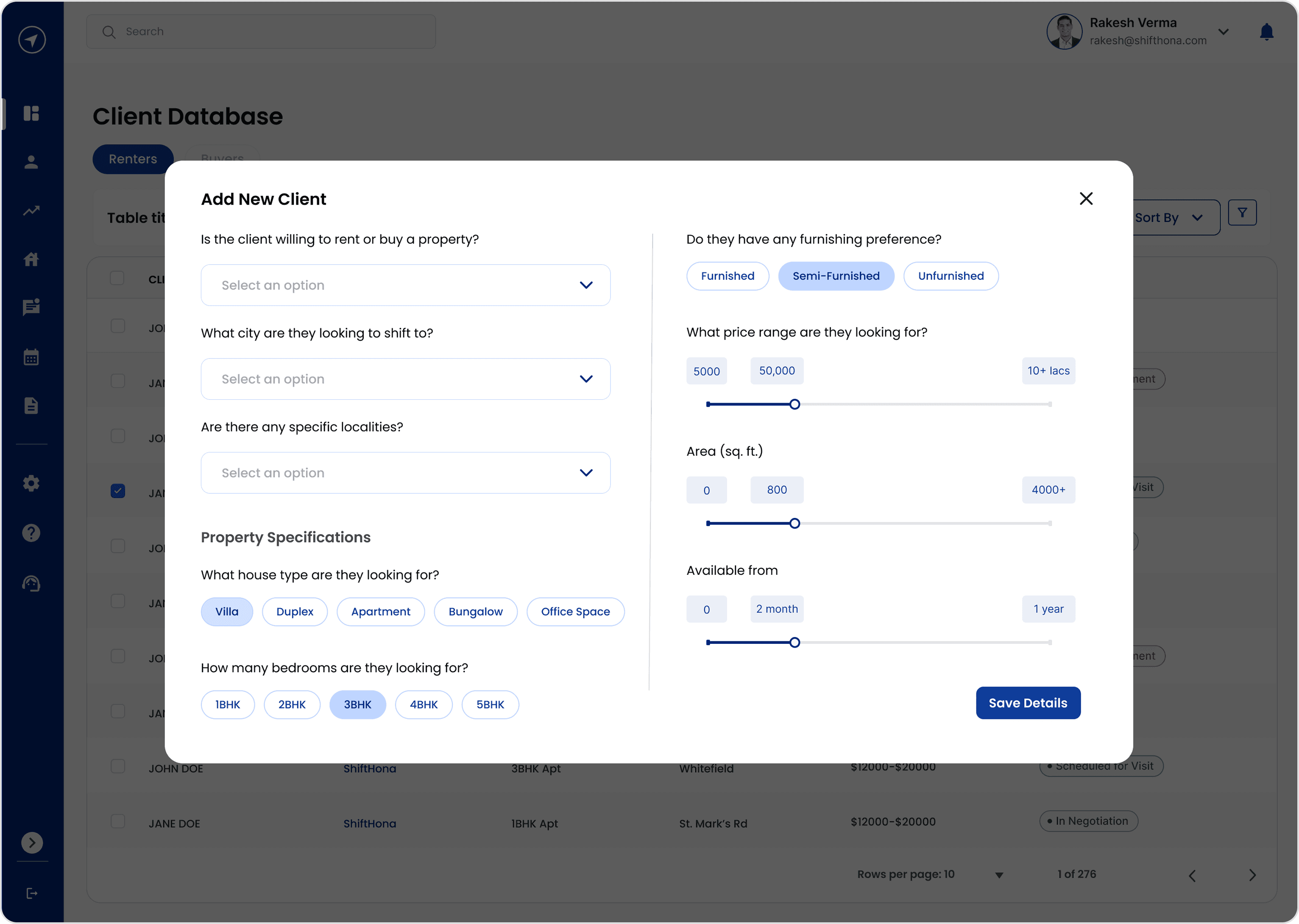
Introducing a quick flow to manually add an offline client into the database and allowing the broker to input all the necessary data about the respective client.
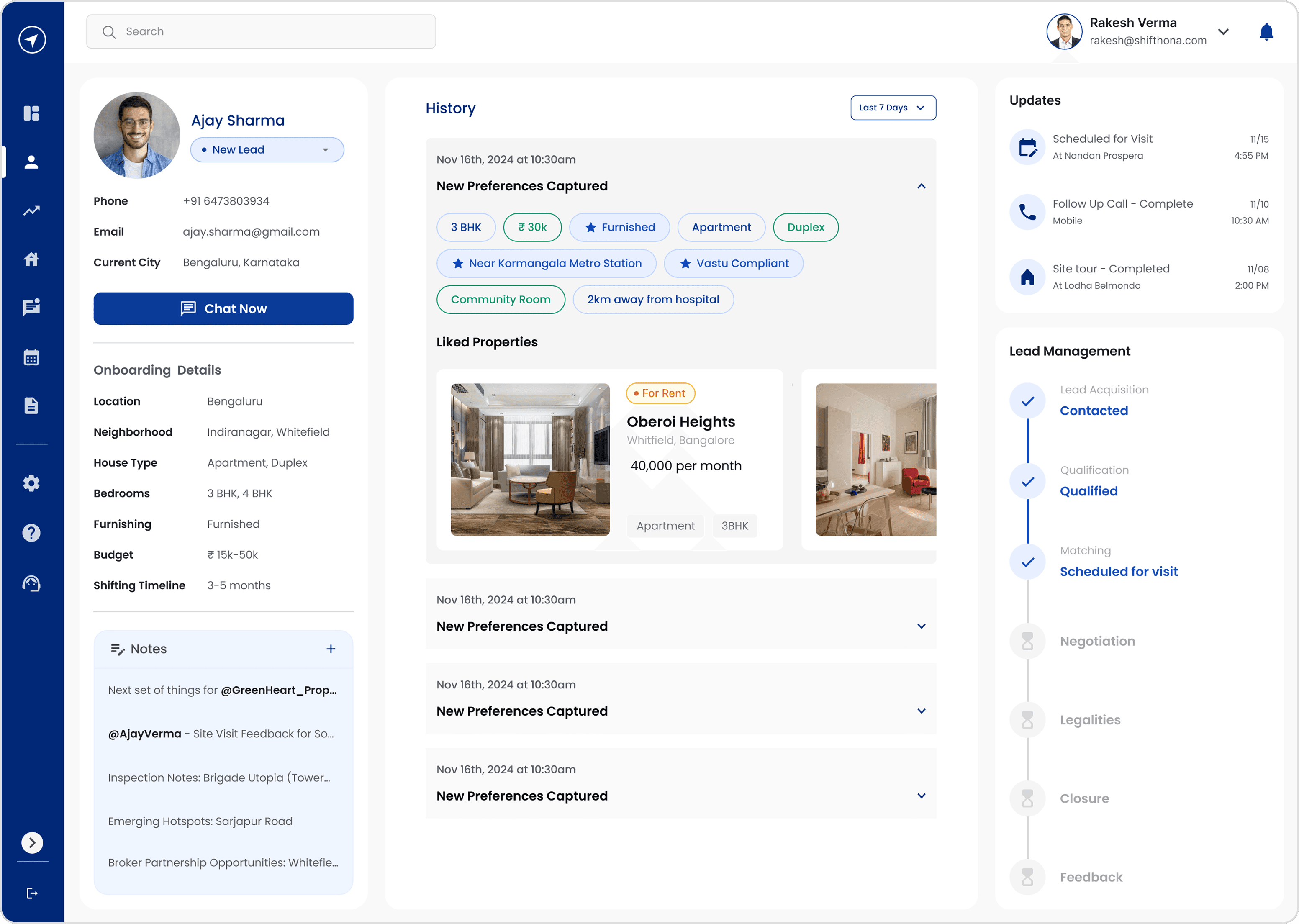
The Client Progress screen tracks preference changes, deal status, and planned activities while allowing brokers to add notes, ensuring a clear overview of client interactions and progress.
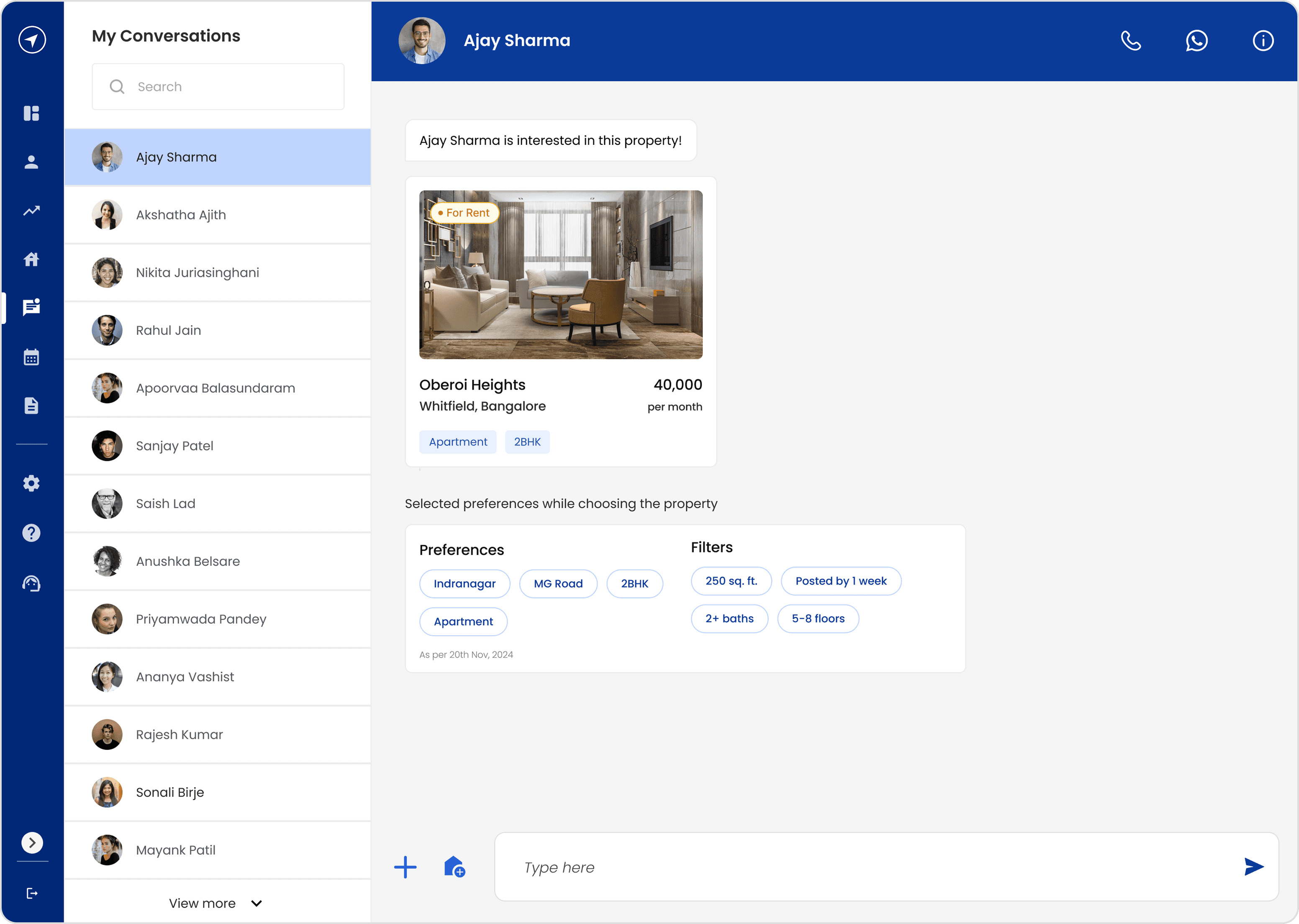
Communication screen centralizes client interactions, showing liked properties and enabling direct messaging via CRM, WhatsApp, or calls, while allowing brokers to quickly share relevant listings.
Research Overview
For this project, our goal was to understand how trust, lead qualification, and evolving preferences function within India’s broker driven real estate ecosystem and where existing tools fail to support real world workflows.
I contributed through desk research, broker and renter interviews, contextual inquiries, and analysis of sponsor-provided broker interviews. I mapped these findings into ecosystem flows and opportunity areas that directly informed our CRM strategy.
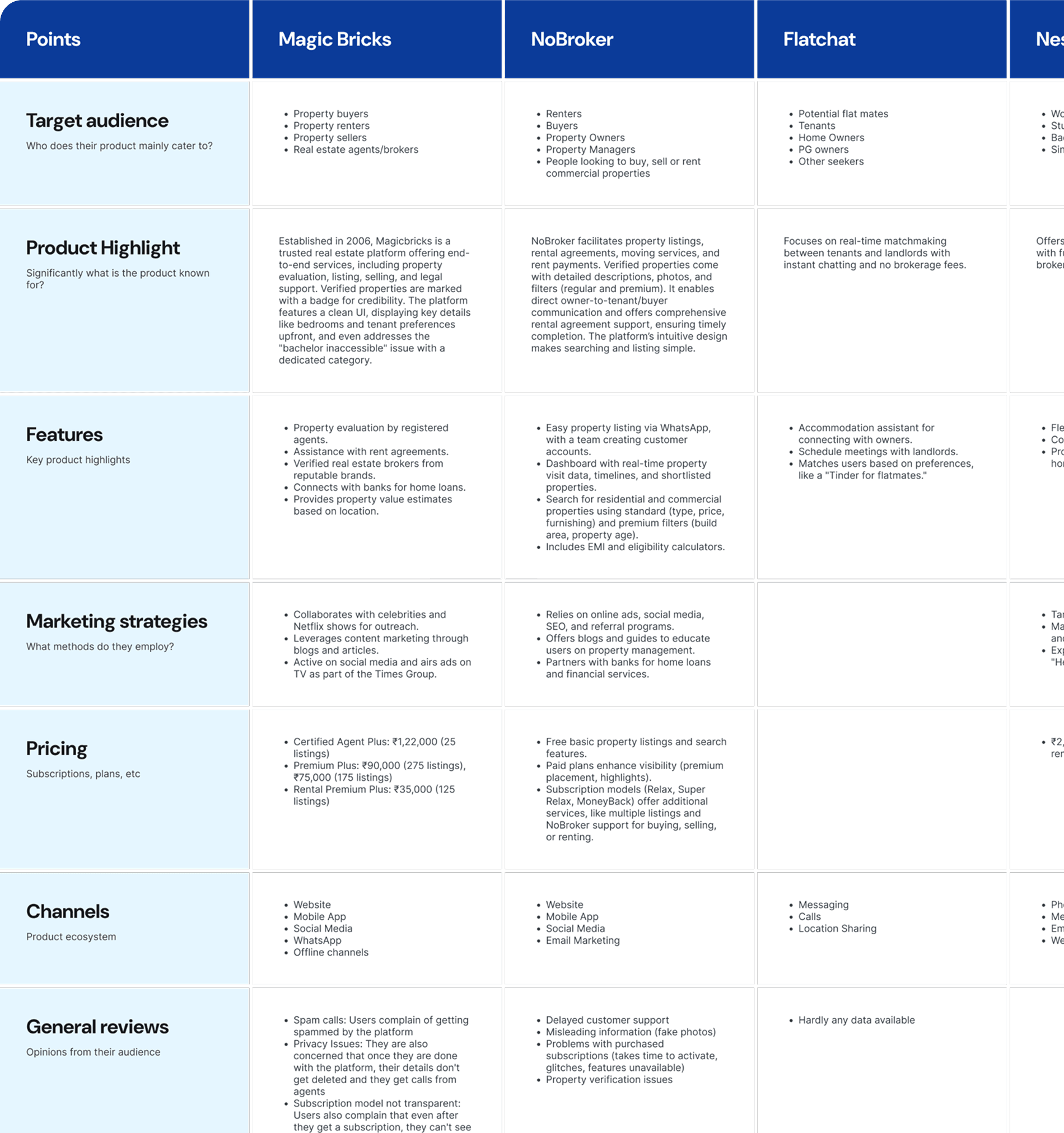
We analyzed eight leading Indian PropTech platforms to identify whether inefficiencies stemmed from platform design or broker workflows.
I evaluated each across lead capture depth, filtering logic, broker tooling, and trust mechanisms.

We conducted 25+ broker interviews and analyzed sponsor-provided recordings to understand how leads are evaluated, prioritized, and converted in real-world workflows.
I synthesized interview patterns, extracted recurring behavioral themes, and mapped broker pain points to CRM opportunity areas.
We get a lot of inquiries, but most of them aren’t serious. I end up calling each person just to figure out if they’re actually planning to move or just browsing.
All the real conversations happen on WhatsApp. By the time the deal progresses, nothing meaningful is inside the CRM.
You can’t reduce a client to a number or score. Sometimes I can tell within five minutes whether they’re serious... but no software captures that intuition.
A client’s requirements change constantly... budget, area, even property type. There’s no system that tracks those shifts, so I have to remember or scroll back through chats.
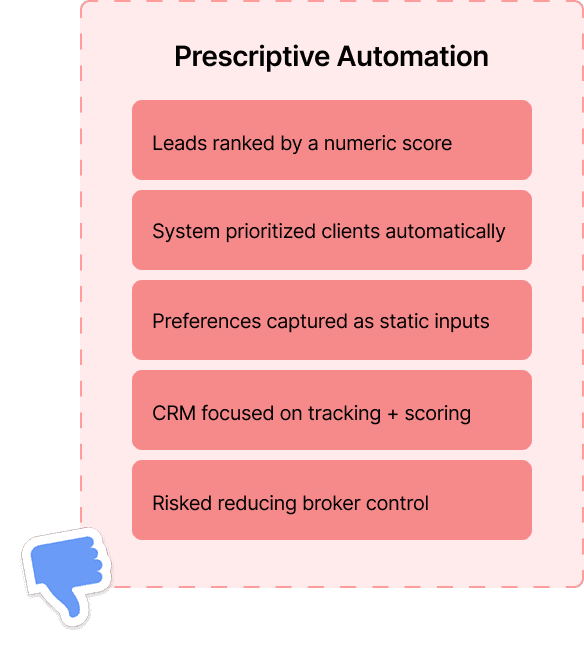
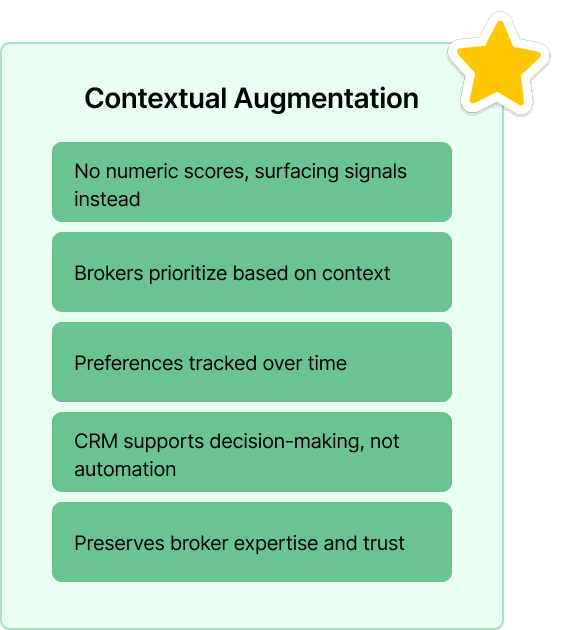
We presented an early CRM concept centered on automated match scoring to validate alignment with stakeholder vision.
But during concept evaluation, we learnt that prescriptive scoring could undermine broker trust and expertise, we pivoted toward an AI-assisted signal dashboard that supports rather than replaces broker judgment.
Evaluation
We conducted structured validation sessions with 16 brokers to evaluate lead triage clarity, preference tracking, and trust in AI-assisted signals. I facilitated several walkthroughs of the dashboard and client profile flows to assess interpretability and workflow impact.
Key Insights
Signal visibility improved prioritization
Most brokers could quickly identify high-intent leads when engagement patterns were surfaced clearly.
Preference timelines reduced cognitive load
Tracking evolving requirements in one view eliminated reliance on memory and chat history.
Simplicity increased trust
High-level summaries with optional drill down performed better than metrics heavy dashboards.
Control was critical for adoption
Brokers welcomed AI insights, but only when final decisions remained manual.
Reflection
This project reinforced that automation must respect expertise. The real opportunity wasn’t replacing broker judgment, but structuring signals to strengthen it. I learned that designing for trust, adaptability, and real-world workflows is what turns a feature into a product.