EGO Movement

EGO Movement

Designing a premium e-commerce system that increases conversion without compromising brand trust
TL;DR

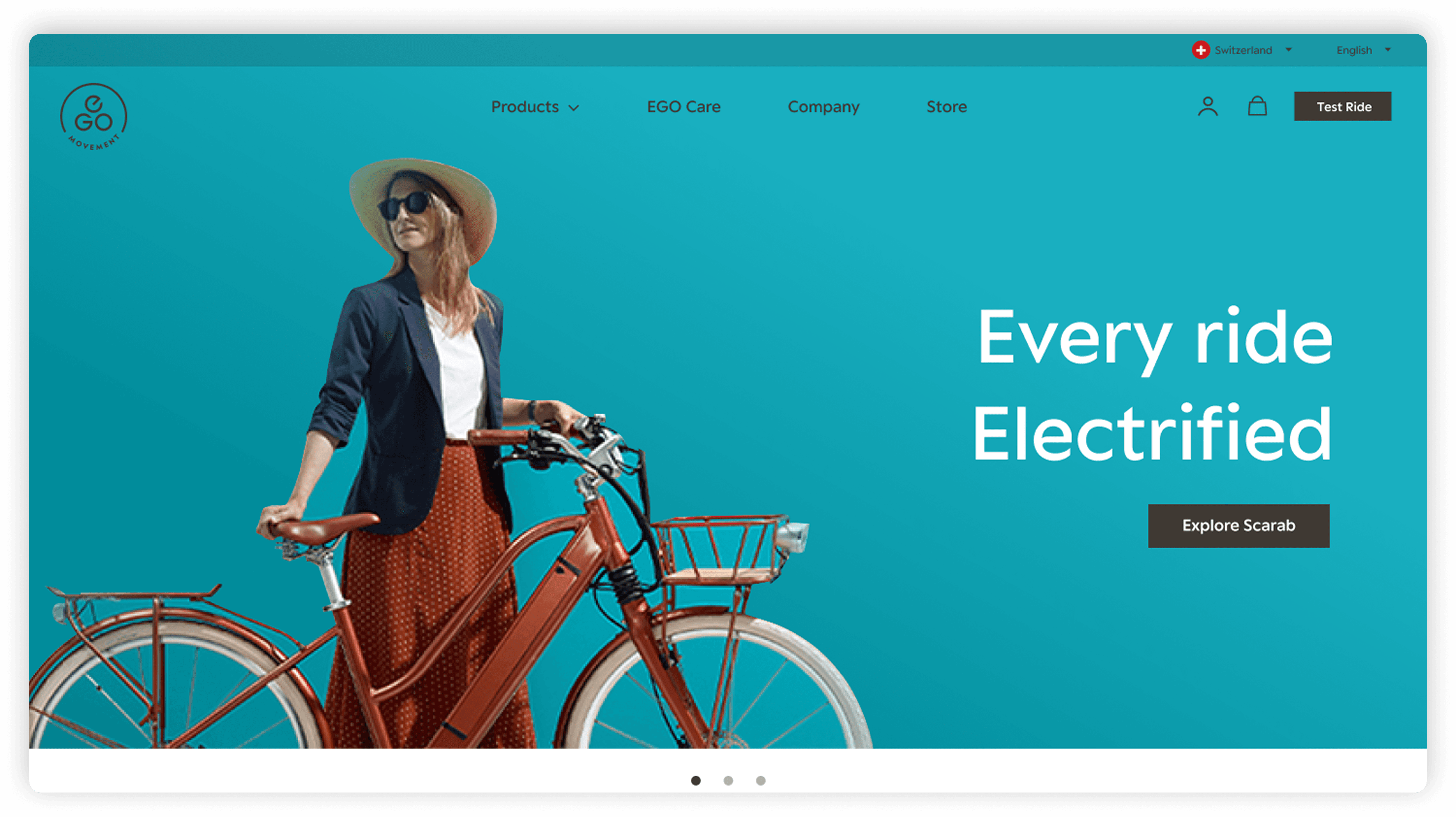
EGO Movement, a Swiss premium e-bike brand, needed its digital experience to match its product craftsmanship while driving measurable growth.

Over 8 months, I led UX research, information architecture redesign, and critical conversion flows across browsing, test drive booking, and checkout.

By diagnosing navigation breakdowns, prioritizing high-leverage user journeys, and introducing transparent pricing and privacy-safe recommendation systems, the redesign improved clarity, increased conversions by 45%, and enabled 72% successful purchase completion.

A group of people emoji

Team

2 Product Manager
1 UX Lead
1 UX Designer

2 UI Designer

Toolbox emoji

Tools Used

Figma, Axure RP, Microsoft Office 365

Calendar Emoji

Team

10 months (April ‘23 - Feb ‘24)

Impact

The redesign generated measurable and modelled improvements.

45% Conversion Lift

Increase in overall conversions after introducing transparent EMI visibility on product pages.

15.8% Organic Visit-to-Lead Growth

Improvement in high-intent traffic converting into qualified leads post-IA optimization.

7K+ High-Intent Page Traffic Increase

Growth in visits to product and checkout pages following navigation design.

45% Conversion Lift

Increase in overall conversions after introducing transparent EMI visibility on product pages.

15.8% Organic Visit-to-Lead Growth

Improvement in high-intent traffic converting into qualified leads post-IA optimization.

7K+ High-Intent Page Traffic Increase

Growth in visits to product and checkout pages following navigation design.

Context

EGO Movement builds premium urban e-bikes rooted in sustainability and minimalist design. Their products are high-consideration purchases- customers compare carefully, evaluate financing, and seek reassurance before committing.

When I joined, the website reflected strong aesthetics but lacked structured support for decision-making. The business goals were clear but the challenge was to balance storytelling with performance-driven commerce.
Business Goals

Reflect premium brand identity

Improve lifestyle-based discovery

Increase cart value

Improve conversion rates

Problem Space

Despite strong brand perception and premium product quality, EGO Movement’s digital experience was not effectively converting interest into action. The website introduced friction during product exploration and checkout which created uncertainty in a high-consideration purchase journey. Some specific issues were:


Navigation complexity slowed discovery and diluted premium perception

Navigation complexity slowed discovery and diluted premium perception

Users struggled to understand which bike fit their lifestyle

Users struggled to understand which bike fit their lifestyle

Product comparison lacked structured clarity

Product comparison lacked structured clarity

Checkout felt long and unpredictable, increasing abandonment

Checkout felt long and unpredictable, increasing abandonment

Financing visibility was limited, reducing transparency and trust

Financing visibility was limited, reducing transparency and trust

Problem Statement

How might we redesign EGO Movement’s e-commerce experience to reduce decision friction, increase transparency, and guide users confidently from discovery to purchase without compromising its premium positioning?

Design Highlights

Rather than redesigning everything at once, I focused on the parts of the experience that most directly influenced trust and conversion.

Flow Prioritization Based on Business Impact

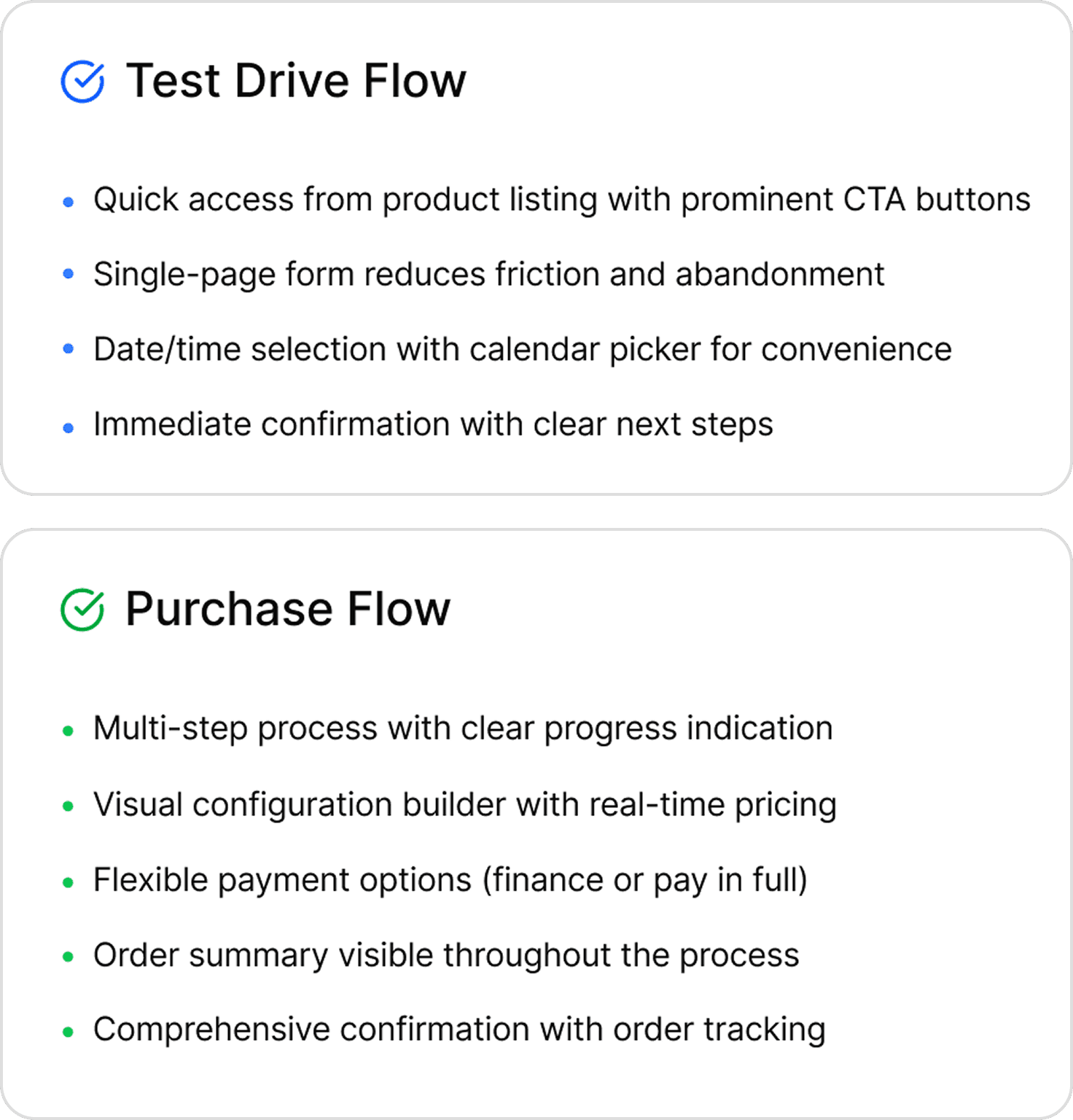
Given timeline constraints, I focused on two high-impact flows as they represented the strongest conversion opportunities and allowed measurable improvement within scope.
Information Architecture Redesign

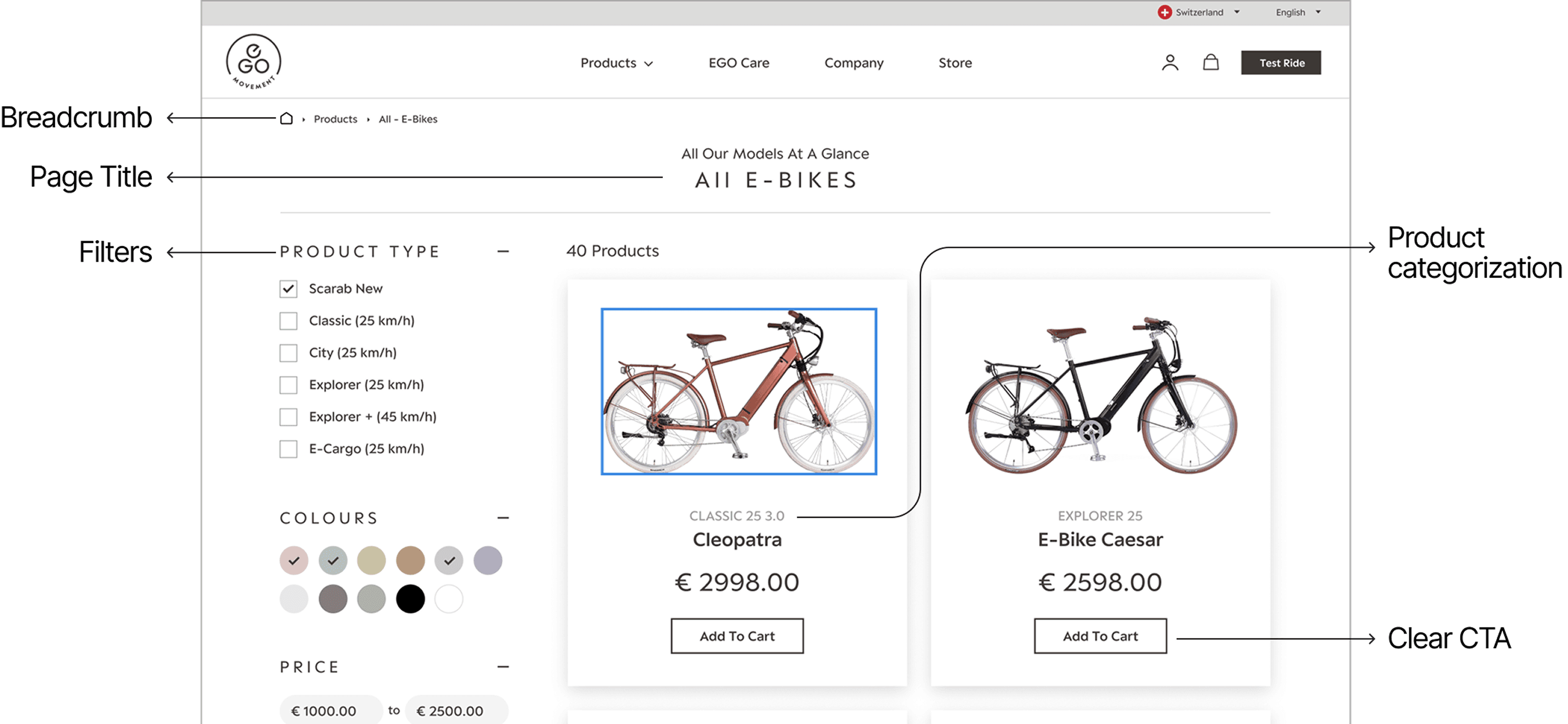
Research indicated that navigation ambiguity reduced confidence and slowed product exploration. I restructured the IA to introduce a clearer hierarchy, lifestyle categorization, and intent-driven pathways.
Desktop-First Strategy

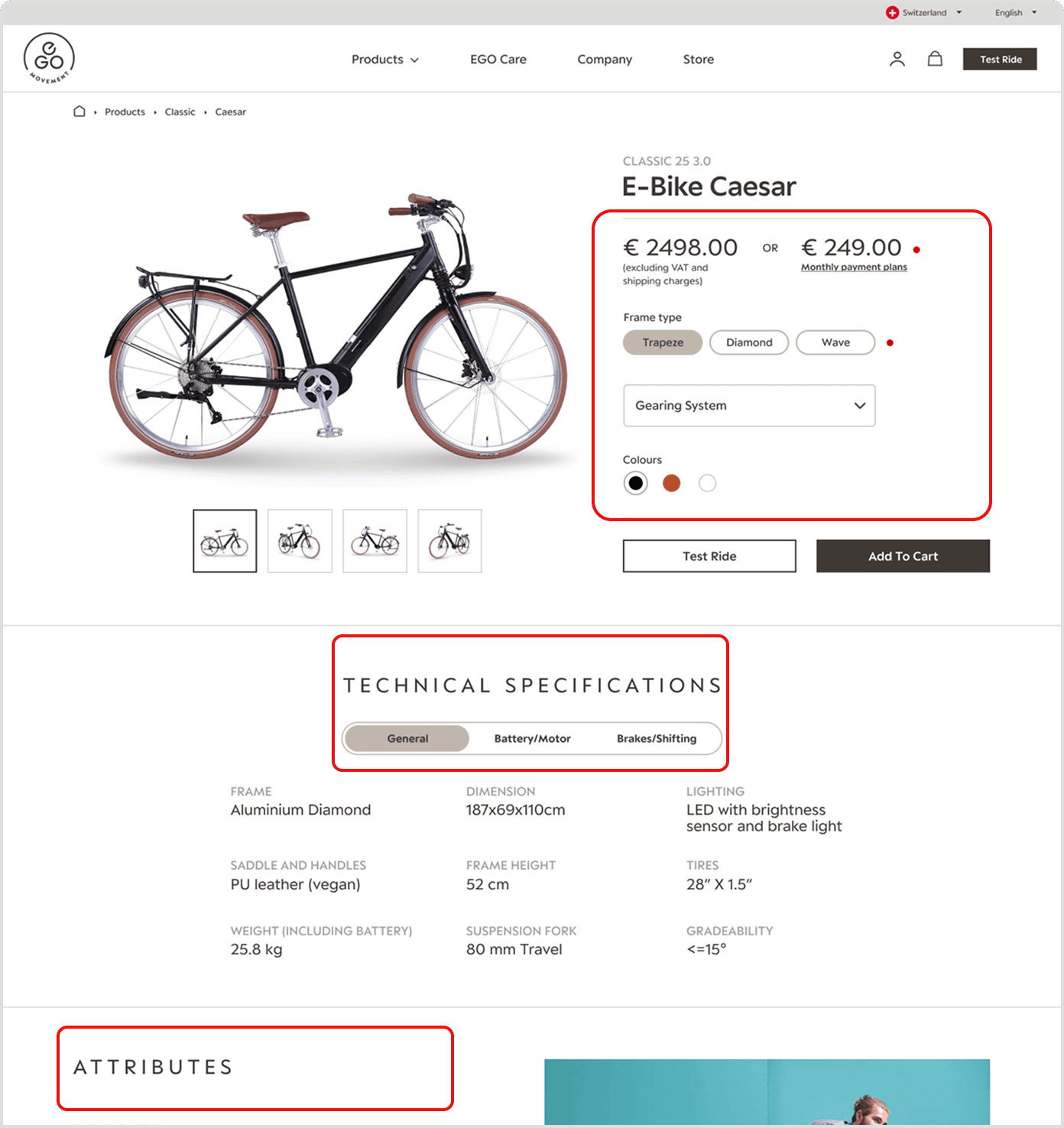
Analytics revealed that high-value purchases were predominantly completed on desktop, so we adopted a desktop-first approach to support deeper evaluation and structured comparison.
Information Architecture Redesign

Research indicated that navigation ambiguity reduced confidence and slowed product exploration. I restructured the IA to introduce a clearer hierarchy, lifestyle categorization, and intent-driven pathways.

GDPR-Compliant Recommendations

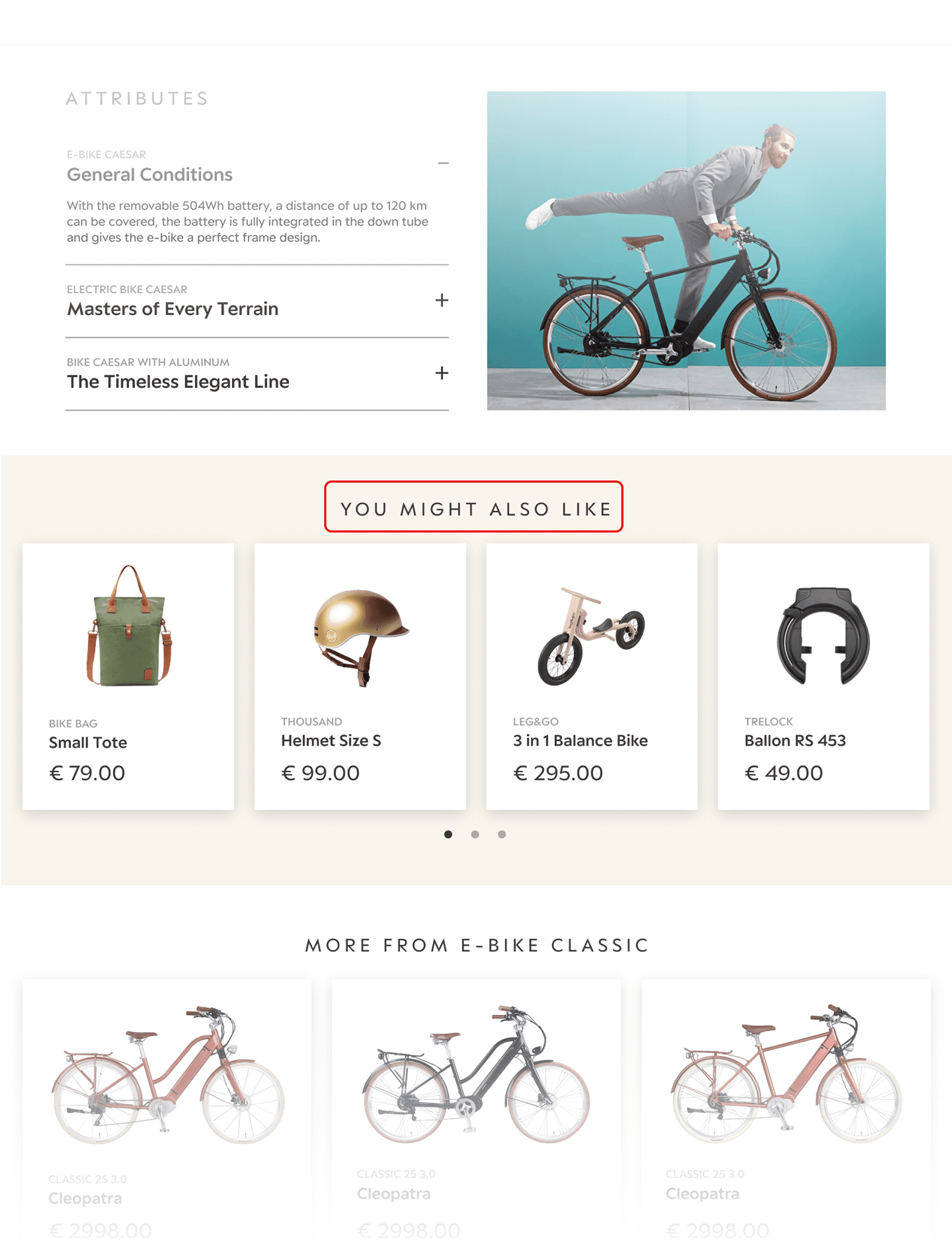
To increase cart value while complying with GDPR restrictions on behavioral tracking, I implemented aggregated “Frequently Purchased Together” recommendations that preserved user privacy while still enabling effective cross-sell.
Research Overview

I set out to diagnose where hesitation occurred in the high-consideration purchase journey and determine whether friction stemmed from brand perception, navigation structure, or checkout uncertainty.

Rather than assuming that a visual redesign was needed, I structured the research to isolate structural vs. behavioral breakdowns.

Research Strategy

To answer our questions, I led a focused, layered approach where each method tested a specific assumption.


Facilitated a discovery workshop to align on business metrics and hypotheses

Facilitated a discovery workshop to align on business metrics and hypotheses

Conducted a heuristic audit (Nielsen Norman framework) to identify structural friction

Conducted a heuristic audit (Nielsen Norman framework) to identify structural friction

Benchmarked premium motorcycle brand websites to understand decision-support patterns

Benchmarked premium motorcycle brand websites to understand decision-support patterns

8+ semi-structured user interviews to uncover hesitation points, comparison behavior, and purchasing factors

8+ semi-structured user interviews to uncover hesitation points, comparison behavior, and purchasing factors

User journey mapping to visualize drop-offs across evaluation and checkout stages

User journey mapping to visualize drop-offs across evaluation and checkout stages

Google Analytics analysis to validate device behavior and quantify friction points

Google Analytics analysis to validate device behavior and quantify friction points

Facilitated a discovery workshop to align on business metrics and hypotheses

Conducted a heuristic audit (Nielsen Norman framework) to identify structural friction

Benchmarked premium motorcycle brand websites to understand decision-support patterns

8+ semi-structured user interviews to uncover hesitation points, comparison behavior, and purchasing factors

User journey mapping to visualize drop-offs across evaluation and checkout stages

Google Analytics analysis to validate device behavior and quantify friction points

Key Insights

  1. Decision Friction During Evaluation

  1. Decision Friction During Evaluation

Users struggled to confidently compare bikes and determine lifestyle fit, slowing movement from exploration to commitment.

Users struggled to confidently compare bikes and determine lifestyle fit, slowing movement from exploration to commitment.

2. Navigation Undermined Premium Perception

2. Navigation Undermined Premium Perception

Ambiguous hierarchy and redundant pathways reduced clarity, weakening trust in a high-consideration purchase environment.

Ambiguous hierarchy and redundant pathways reduced clarity, weakening trust in a high-consideration purchase environment.

3. Checkout Anxiety Reduced Completion

3. Checkout Anxiety Reduced Completion

Lack of progress visibility and unclear effort expectations increased hesitation during the final purchase stages.

Lack of progress visibility and unclear effort expectations increased hesitation during the final purchase stages.

4. Desktop Dominates High-Value Purchases

4. Desktop Dominates High-Value Purchases

Analytics revealed that Millennials preferred desktop for expensive purchases, influencing prioritization of platform optimization.

Analytics revealed that Millennials preferred desktop for expensive purchases, influencing prioritization of platform optimization.

5. Transparency Drives Conversion

5. Transparency Drives Conversion

Financing visibility and clear pricing information increased user confidence, directly impacting conversion performance.

Financing visibility and clear pricing information increased user confidence, directly impacting conversion performance.

6. Personalization Must Respect Privacy

6. Personalization Must Respect Privacy

Cart value could be improved through recommendations, but GDPR constraints required privacy-safe, aggregated approaches.

Cart value could be improved through recommendations, but GDPR constraints required privacy-safe, aggregated approaches.

Tradeoffs

Throughout the redesign, I navigated tradeoffs between ambition, brand positioning, and system limitations to prioritize measurable outcomes.

Transparency vs. Premium Positioning

Despite initial hesitation around surfacing EMI financing, research showed that pricing clarity reduced hesitation. Introducing EMI visibility directly on product pages resulted in a 45% increase in conversions.

Designing Within Technical Constraints

Magnolia CMS limited search tuning and personalization. I prioritized stronger filtering, synonym mapping, and clear hierarchy to improve findability without increasing technical complexity.
Focus Over Feature Expansion

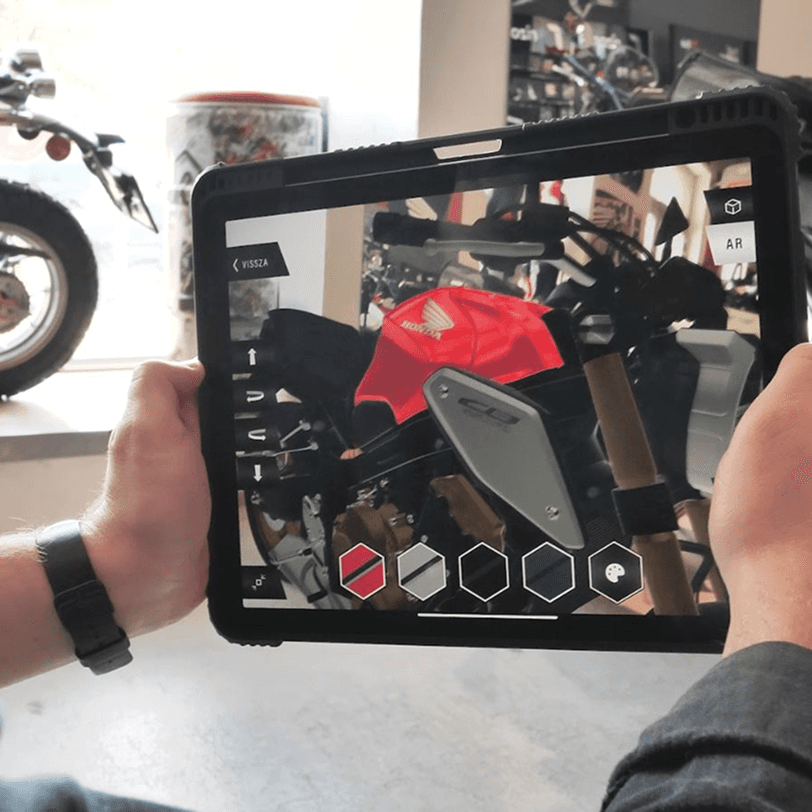
While immersive features (AR/360) were explored, research revealed structural friction in evaluation and checkout. We prioritized optimizing high-impact conversion flows over expanding experiential features.

Reflection

This project reinforced that strong product design sits at the intersection of clarity, alignment, and execution.

I learned that effective UX requires translating between users, business stakeholders, and developers. Design impact depends as much on cross-functional alignment as it does on interface quality.

Balancing stakeholder ambition, technical constraints, and user needs required continuous adjustment. Strong design isn’t rigid, it evolves through feedback and context.

Clear articulation from client presentations to developer handoffs was essential to turning strategy into shipped outcomes. Vision only matters if it can be operationalized.

This project reinforced that UX sits at the intersection of user value and business performance.

The designer’s role is not just to craft interfaces, but to align systems toward measurable impact.

This project reinforced that UX sits at the intersection of user value and business performance. The designer’s role is not just to craft interfaces, but to align systems toward measurable impact.

Work

Resume